Document HEL-GDE-01 · An honest making-of
How this site
was made.
HELIOS is a fictional observatory, built end-to-end by an AI agent, Claude Fable 5, as a demonstration of autonomous web design. No templates, no stock assets, no human pixel-pushing. Here is exactly what it is and how to reproduce it.
A living instrument, not a brochure
The brief: a deep-space sky-survey institute whose website behaves like one of its own
instruments. So the hero is a real-time simulation, the numbers tick like a control room,
and the chrome (hairline rules, tick marks, coordinates pinned in the corners) borrows
from telescope engineering drawings. Two colors only: cyan #7be8ff for starlight
and instrumentation, solar orange #ff9a3c for the institute's namesake. Type is
Space Grotesk for prose and Space Mono for every number, served from
fonts.bunny.net.
What is actually running
- 100 000-point particle galaxy: a three.js (v0.160, ES modules off
jsdelivr)
BufferGeometryrendered asPointswith a custom GLSL shader: 3-arm logarithmic spiral distribution, per-point size attenuation, additive blending, and a soft-disc fragment falloff. - Curl-noise drift: a simplex-noise field sampled six times per vertex builds a divergence-free curl vector, so the galaxy breathes instead of jittering. Differential rotation (inner stars orbit faster) runs on top.
- Gravity well: the pointer is raycast onto the galactic plane; a Gaussian force with a tangential swirl term pulls and brightens nearby stars.
- Scroll parallax: two background star layers translate at different
rates while the camera dollies back, all driven by
window.scrollY. - Constellation navigation: inline SVG lines with measured
stroke-dasharraylengths animatestroke-dashoffsetto draw themselves; each star is an anchor into the page. - Fake telemetry: plain JS intervals random-walk photon rates, seeing,
RA pointing, and alert counts inside believable physical bounds. The moon illumination is
genuinely computed from the synodic month. Everything respects
prefers-reduced-motionby freezing to a single honest frame.
Three passes, screenshot-verified
The site was built in a loop: write, serve locally, screenshot at desktop and 390 px mobile widths with a headless browser, read the images, self-critique, fix. Three full passes ran before deploy.
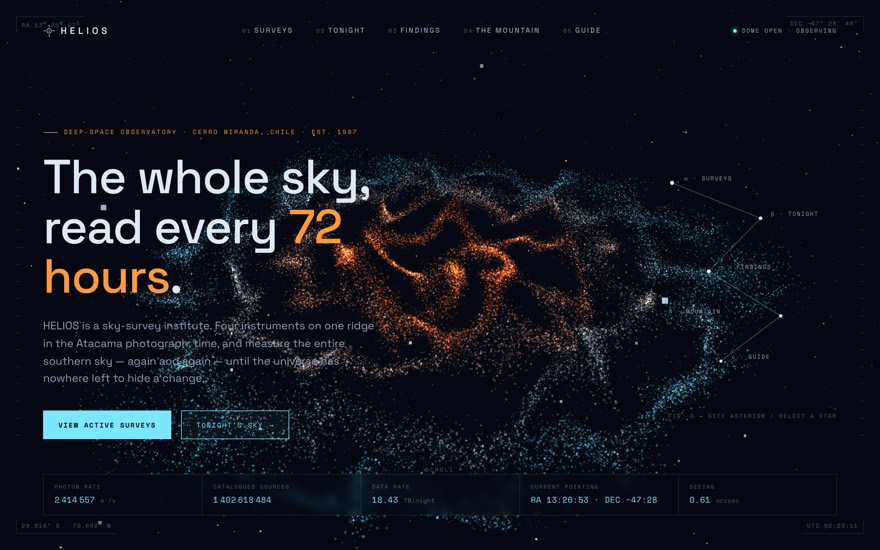
PASS 1 · STRUCTURE
All sections written with real copy, galaxy shader running, console clean. Critique: the live-alert ticker was an empty box, and reveal animations exposed a glowing gap behind the mission cards.
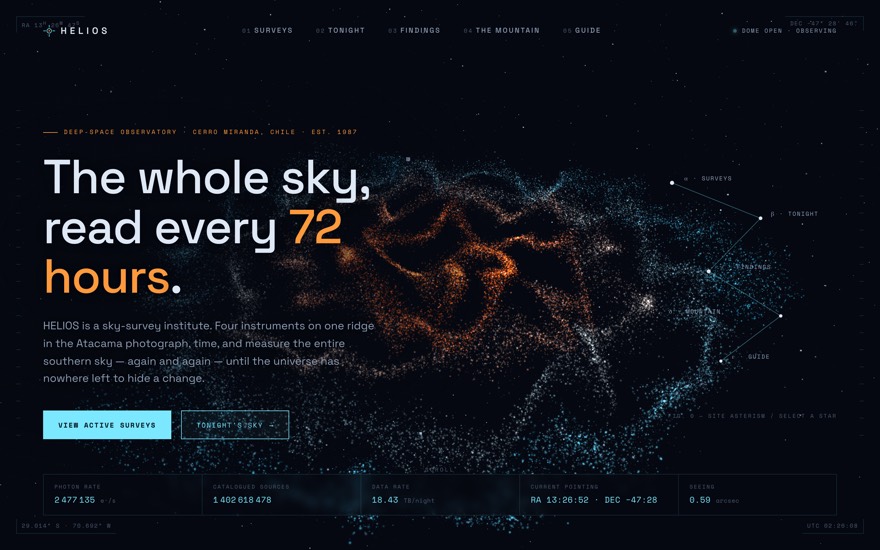
PASS 2 · HIERARCHY
Fed the alert stream with generated transients, fixed the card-reveal artifact, added a radial scrim so the hero copy stays legible over the galaxy's orange core, gave anchors scroll margins.
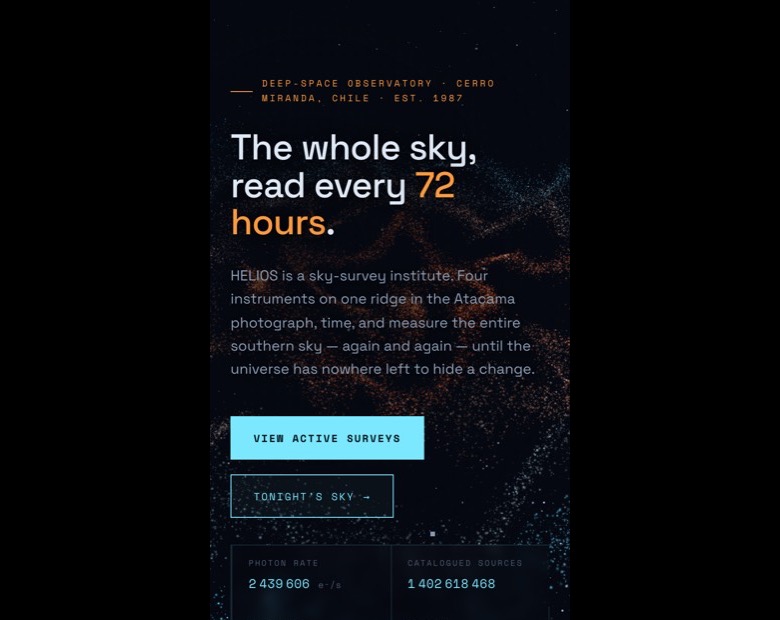
PASS 3 · POLISH
Mobile pass at 390 px: swapped the truncating pointing cell for seeing, verified contrast on every label, confirmed Space Grotesk and Space Mono actually rendered, checked reduced-motion, then shipped.
Prompting an agent to build this
Any capable coding agent with a browser-screenshot tool can build this. The prompt that matters is specific about physics, palette, and verification:
The honest secret is the loop, not the prompt: an agent that looks at its own output, names five flaws, and fixes them will beat one perfect first draft every time.